
Saturday, March 19, 2005 — Shortly after I arrived in Germany, a work colleague from another US state, who was there for the same reason, joined me. Now I had a traveling companion. During the workweek, we explored the Erlangen area together and got to know it very well. By the weekend, we wanted to expand our range and decided to go to the city of Bamberg.
The city is located directly north of Erlangen in the Upper Franconia region of Bavaria, Germany. We took a train from the Erlangen Station, and it took approximately 25 minutes to arrive at the Bamberg Station.
Bamberg has been a recorded settlement for over 1,120 years and a major center of civic and religious power for more than 1,000 years. According to historical records, Bamberg was first documented in AD 902 as Castrum Babenberch, the castle seat of the East Franconian Babenberg family.
In AD 1007, King (later Holy Roman Emperor) Henry II accelerated Bamberg’s development into a major city when he established the Bishopric (Diocese) of Bamberg. He had a vision of transforming the town into a "second Rome." The city expanded and prospered during the Middle Ages, developing distinct civic and religious sectors—including the famous Old Town Hall (Altes Rathaus), built in the middle of the Regnitz River during the 14th century.
Bamberg was designated a UNESCO World Heritage Site in 1993 because its medieval layout and historic architecture survived World War II largely undamaged.
When we did our walking tour of the city, every view could be framed into a beautiful photo. I captured as many as I could, but it still didn't feel like enough.
When we completed our visit to Bamberg, there was still plenty of time left, so we took a train to Nuremberg.
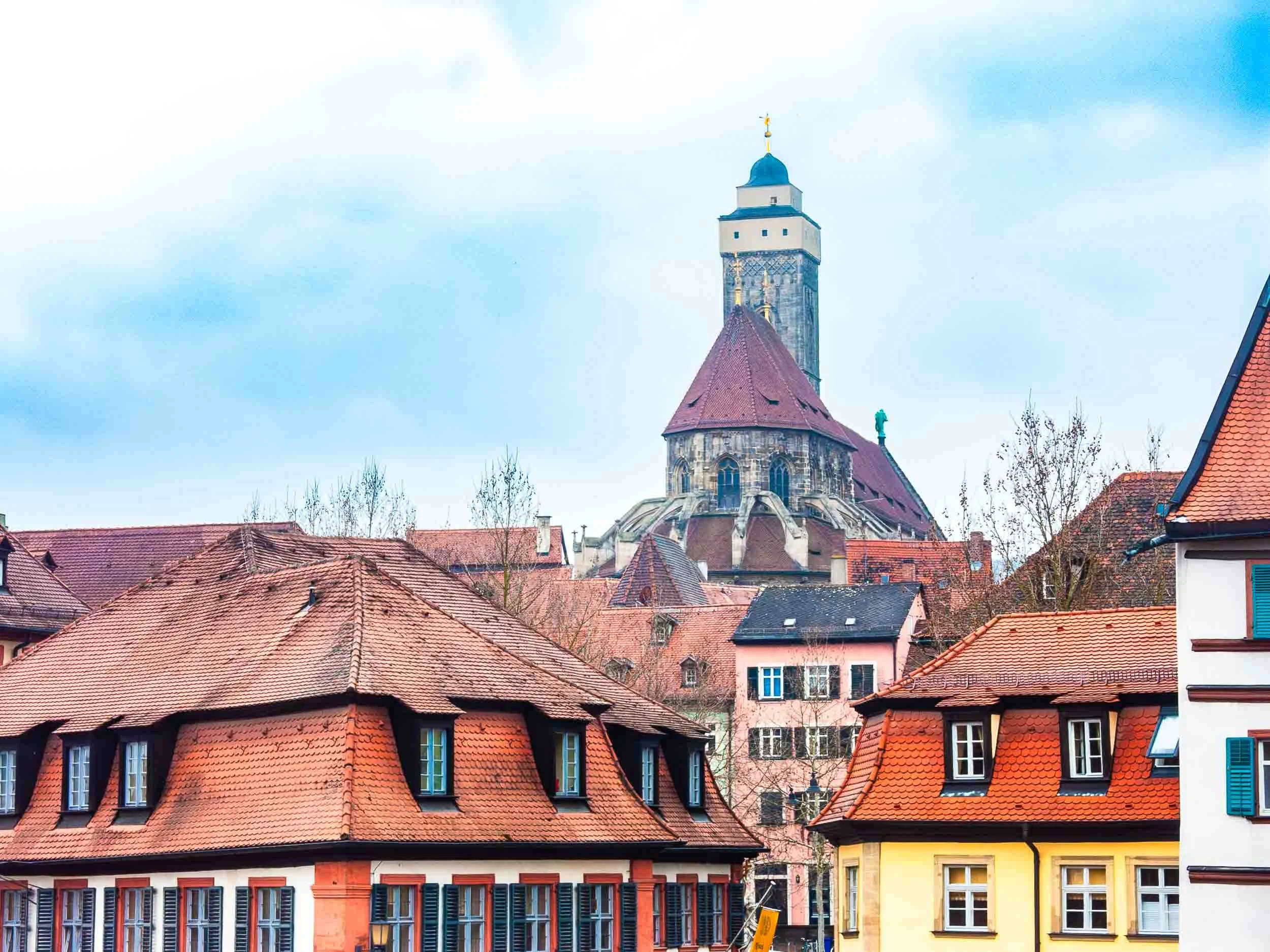
Obere Pfarre (Church of Our Lady)
This High Gothic church on the hill, towering above the foreground buildings, started construction in 1338 on a site that previously had a 12th-century structure. The three-nave body of the church was completed and consecrated in 1387. The overall building structure was largely completed around 1450. The two-story tower lantern of the single central tower was added in 1537 - 1538.
Pope Clement II (1005 to 1047
Born Suidgar von Morsleben. He was formerly Bishop of Bamberg. He became Pope December 25, 1046 and served until his death on October 9, 1047. He was nominated by King Henry III of Germany. His tomb and recumbent effigy (gisant), seen here, is located in the western choir of the Bamberg Cathedral (Bamberger Dom).
Bamberg Cathedral (Bamberger Dom St. Peter und St. Georg)
Viewed looking towards its eastern choir and eastern towers from Domplatz. The original structure began in 1002 and King (later Holy Roman Emperor) Henry II and was completed and consecrated in 1012. The original was destroyed by fires in the 11th and 12th centuries. The current structure started construction in the 12th century and was completed and consecrated on May 6, 1237.
St. Michaelsberg Abbey (Kloster Michaelsberg/Michaelskirche) Perched on the Hill
Photo taken near Markusbrücke (Markus Bridge) looking southwest across the Regnitz River toward the Michaelsberg hill. The foreground shows hald-timbered houses along Kapuzinerstraße and Am Kranen. The Abbey on the hill was once a Benedictine monastery, but after secularization in 1803 ownership was passed to the city of Bamberg, and today it is a multi-use municipal historic site, that includes: Retirement Home/Social Care Facility; Franconian Brewery Museum; Church; Public Gardens and Terraces.
Regnitz River
It is specifically the left arm of the river (Linker Regnitzarm). The frescoed building on the left is Bamberg’s historic Altes Rathaus (Old Town Hall) which is built in the middle of the river on an artificial island connected by bridges.
Grüner Markt 1 (Green Market 1)
The building located at the intersection of Keßlerstraße and Grüner Marht square. It was built in 1980 but was designed to blend in with Bamberg’s historic Old Town cityscape. It is a mixed-use commercial and residential building, housing retail spaces and boutique shops on the ground floor and apartments on the upper levels.
Related Links: