
Sunday, March 20, 2025 — Some of our work colleagues who are locals arranged to take us on a day trip. They picked us up at our hotel and drove to the Neideck Castle Ruins. Afterwards, we were taken to Ebermannstadt for refreshments, including ice cream and German beer. I was told at the time that the area we were visiting and the beautiful scenery all around us were part of a region in Bavaria known as Franconian Switzerland. Ebermannstadt was called the gateway to Franconian Switzerland. The chief point of interest during our visit was Neideck Castle (Burgruine Neideck); we hiked its vast grounds and got close to some of its refurbished structures.
When we visited the site, I was unaware of its rich medieval history, which accounts for its popularity today, even though its demise started in 1347. History records that in its prime during the 14th century, it was one of Germany’s largest fortresses, spanning 140 by 200 meters. From 1312 it was owned by the powerful Schlüsselberg noble family, who controlled most of the region. In 1347, Count Konrad II von Schlüsselberg angered the bishops in the neighboring cities of Bamberg and Würzburg by illegally imposing a trade toll in the valley. The bishops formed an alliance, besieged the castle, and killed Konrad on September 14, 1347, with a stone fired from a giant catapult (trebuchet). Local lore humorously notes that he was sitting in his "privy chamber" when the rock struck! The castle was destroyed shortly afterward
The castle was rebuilt but burnt down again during the 16th-century wars, after which the ruins were used as a stone quarry. Those stones were used to build the world-famous Würzburg Residence and the Basilica in Gößweinstein.
I enjoyed the visit and took some photos, but it is only now—21 years later—that I can fully appreciate the story told by those photos.
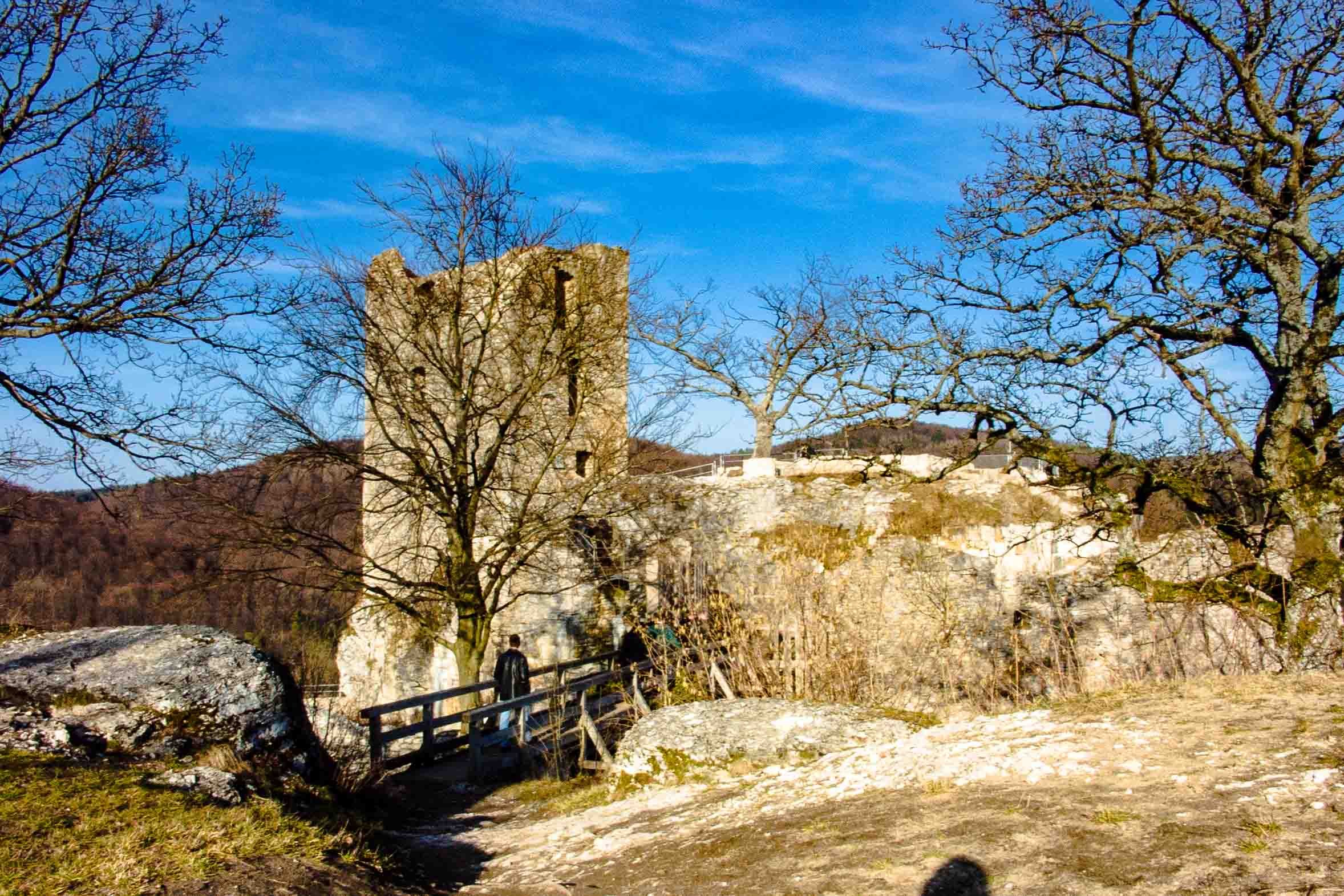
Neideck Castle Ruins
This stone structure is the iconic lookout main tower and the famous landmark of in Franconian Switzerland. The wooden bridge crosses an ancient defensive ditch provides access to the upper courtyard.
Historic Lime Klin
Located in the countryside of Franconian Switzerland. Historically used to produce quicklime by burning local limestone rocks harvested from the surrounding Franconian Jura landscape. it is built from fieldstone featuring a short cylindrical structure with small side openings (draft holes or access ports for loading fuelwood and removing processed lime).
Wiessenttal
Some of my colleagues looking out across the Wiesent Valley (Wiesenttal)
Wiesent Valley Floor
The valley bottom featuring the meandering path of the Staatsstraße 2191/B470 road alongside the meadows and the fields bordering the Wiesent River. In the distance across the valley, nestled at the base of the opposite hills, lies the village of Streitberg. The wooded colomite hills framing the valley opposite Neideck are Hummerstein and Streitburg area; high plateau extending towards the ruins of Streitburg. Trainmeusel/Meadow Farms are the cluster of buildings and houses in the immediate foreground below Neideck Castle.
The Haag Hamlet
A small cluster of historic residential farmhouses, barns, and timber-framed structures nestled at the base of Neideck Castle hill.
Püttlach River Valley and town of Pottenstein
Viewpoint from the terrace wall of Pottenstein. The prominently featured rock outcrop across the valley on the opposite ridge is Prüllrock.
Related Links: