
Sunday, March 13, 2005 - Armed with instructions from the receptionist on how to get to Nuremberg, I walked to the station and got my tickets. I boarded the train when it arrived and got my first reality check: this country speaks German! All information on the train was in German, and the driver/conductor announced the stations as we were arriving at them in German. The sounds he was making did not match the words I saw on the printed signs at the stations. I was not overly concerned because I did not think he could mangle the pronunciation of Nuremberg very much, even though I had heard different pronunciations for it in the past. I became even more relaxed when I heard some young people with American accents a few seats behind me. I moved closer to them and learned that they were American students at the University of Erlangen, and they were also going to Nuremberg.
The train arrived in Nuremberg, and all was well.
When I stepped out of the train station, the first sight left me in awe. It was a very old-looking tower that appeared to be in the middle of the street. The experience was like stepping into a storybook from a long-ago century. I have since learned that it is Frauentorturm (Women’s Gate Tower). There is a caption below in my photo that provides a further explanation of it. I knew then that I was going to like this city. A bit of the storybook sensation was diminished, however, when I glanced to my right and saw a Burger King!
I spent the rest of that Sunday afternoon into the early evening just walking around the city, totally blown away by the architecture, which is so old and intricate that there is a temptation to call it "natural beauty."
My next reality check came back at the train station for the return ride to Erlangen. I did not pay sufficient attention when I got off the train and could not remember which platform to use. With the directions all in German and the station being a large one, I was lost. I took the easy way out and found a cab back to the hotel.
I made two other visits to Nuremberg during my fourteen-day visit, but each time with company. Strange as it may seem, each time we took a cab back to the hotel.
Nuremberg is a fascinating city. The photos below and those in the full gallery only capture a small portion of its beauty.
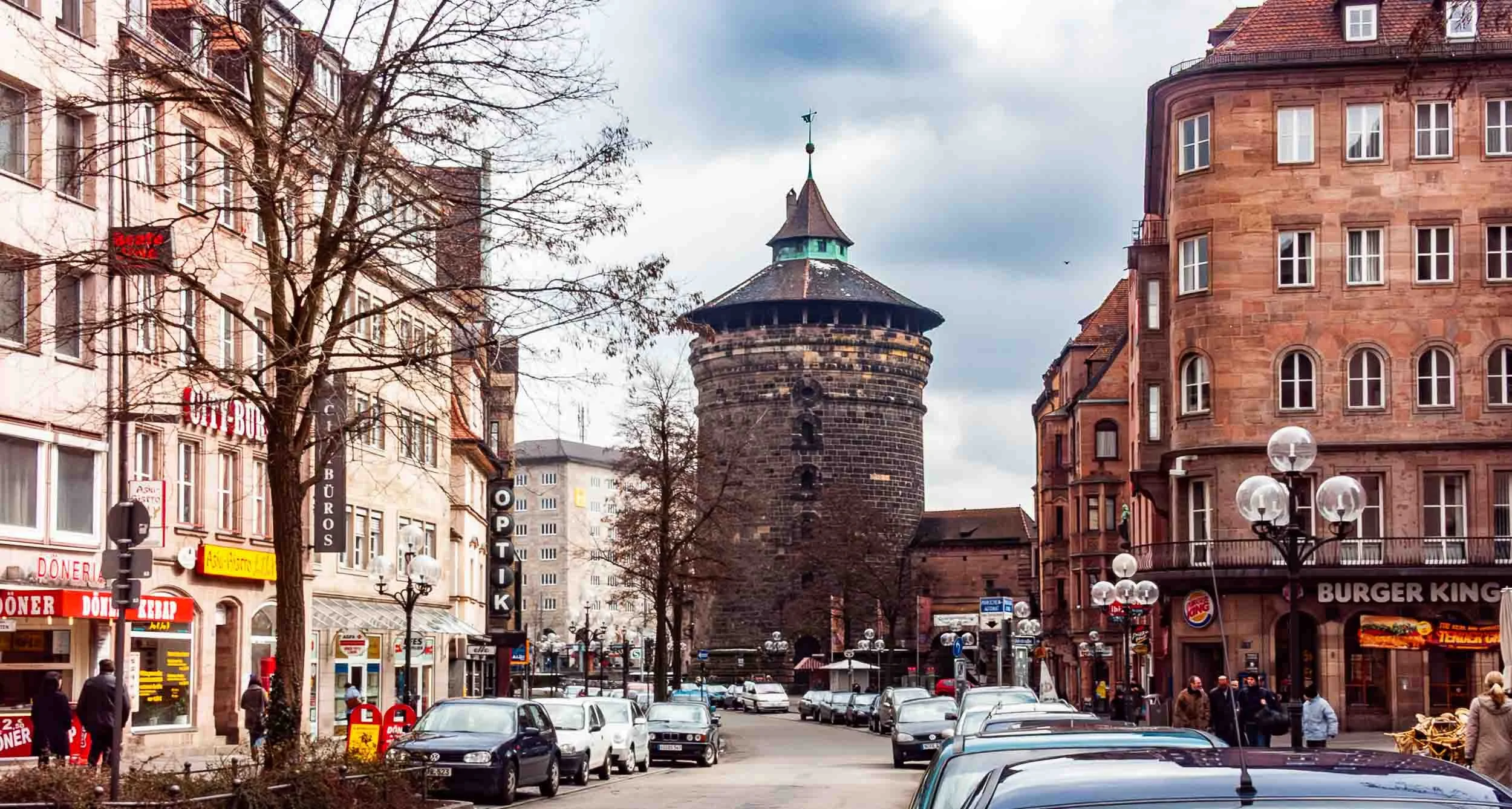
Frauentorturm (Women’s Gate Tower)
Built in the late 14th century and remodeled in 1558. It is one of the four main corner towers guarding the city gates and medieval wall fortification. It is located at the southeastern edge of the Old Town (near the central train station). It became known as the Women’s Gate because it was located close to St. Klara Abbey (a monastery for nuns)
St. Lorenz (St. Lawrence’s Church) in Nuremberg
Construction of this church started between 1243 and 1250 and continued through 1477. It started as Catholic but converted to Lutheran Protestant faith in 1525. It is still Lutheran today. It was severely damaged during World War II, but post-war rebuilding restored it to its historical appearance.
The Schöner (“Beautiful Fountain”)
This is a 14th-century Gothic fountain located in the Hauptmarkt (main market square) of Nuremberg. It was constructed between 1385 and 1396 by Heinrich Beheim and stands approximately 19 meters (62 feet) tall. It features 40 colorful , gilded figures across four tiers, representing the Holy Roman Empire’s worldview. Visible directly behind the fountain is the Frauenkirche (Church of Our Lady).
The Bailey (Outer courtyard) of the Imperial Castle of Nuremberg (Nürnberger Burg)
The prominent round cylindrical stone tower is the Sinwell Tower (Sinwellturn), built in the 13th century. This serves as the castle’s main keep, watchtower and treasurry. The half-timbered building directly in front of the tower is the Deep Well House (Tiefer Brunnen). It houses the historic well shaft cut over 50 meters (160 feet) into the sandstone rock to secure water for the castle.
Bergstraße in the Old Town (Altstadt)
Taken from the slopes near the Kaiserburg. The Wirtshaus Hütt’n is a well-known traditional Franconial tavern at Bergstraße 20. City Hall/Wolffscher Bau is on the left with its prominent green copper roof lanterns and grand Renaissance. Sebalduskirche (St. Sebald Church) spires peeks over the rooftops in the background.
Three interconnected buildings related to the Executioner
Henkerhaus (Executioner’s House): Building on the left, which served as the official residence of the executioner starting in the 16th century.
Henkerturm (Executioner’s Tower): The square sandstone defence tower in the center originally constructed in the 14th century.
Henkersteg (Executioner’s Bridge): The covered bridge on the right allow the executioner to get into the town while keeping him separated from the general public due to the social stigma attached to his job.
The structures span the Pegnitz River.
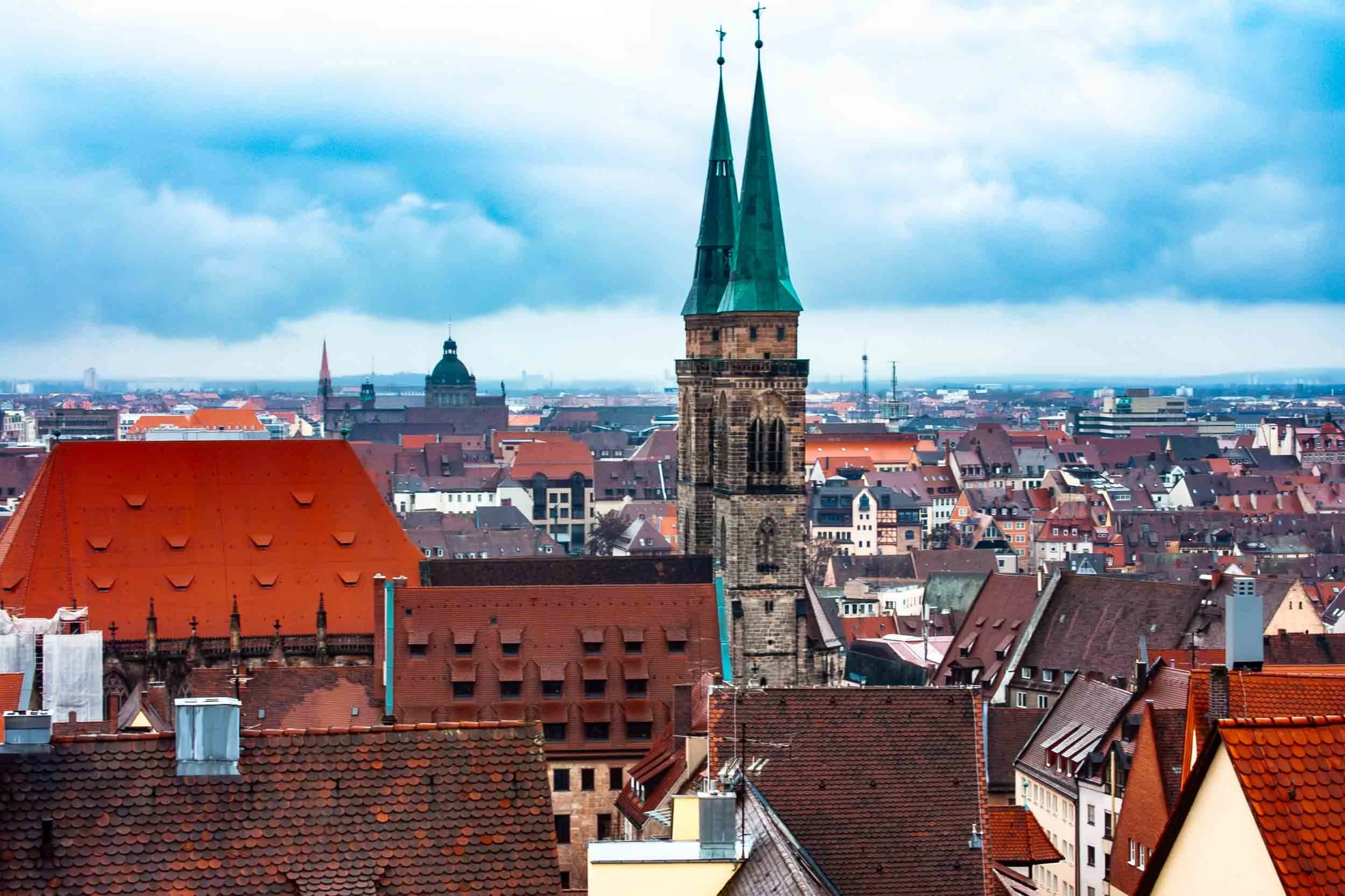
St. Sebaldus Churcu (Sebalduskirche)
This view is looking south over the Old Town (Altstadt) of Nuremberg from the observation terrace of the Nuremberg Castle. This is the oldest parish church (dating back to the 13th century). The large red-tiled roof immediately to the left of the towers belongs to the nave of the church. In the distance background roof lines extending towards the Pegnitz River and the southern side of the Old Town can be seen.
Related Links: